

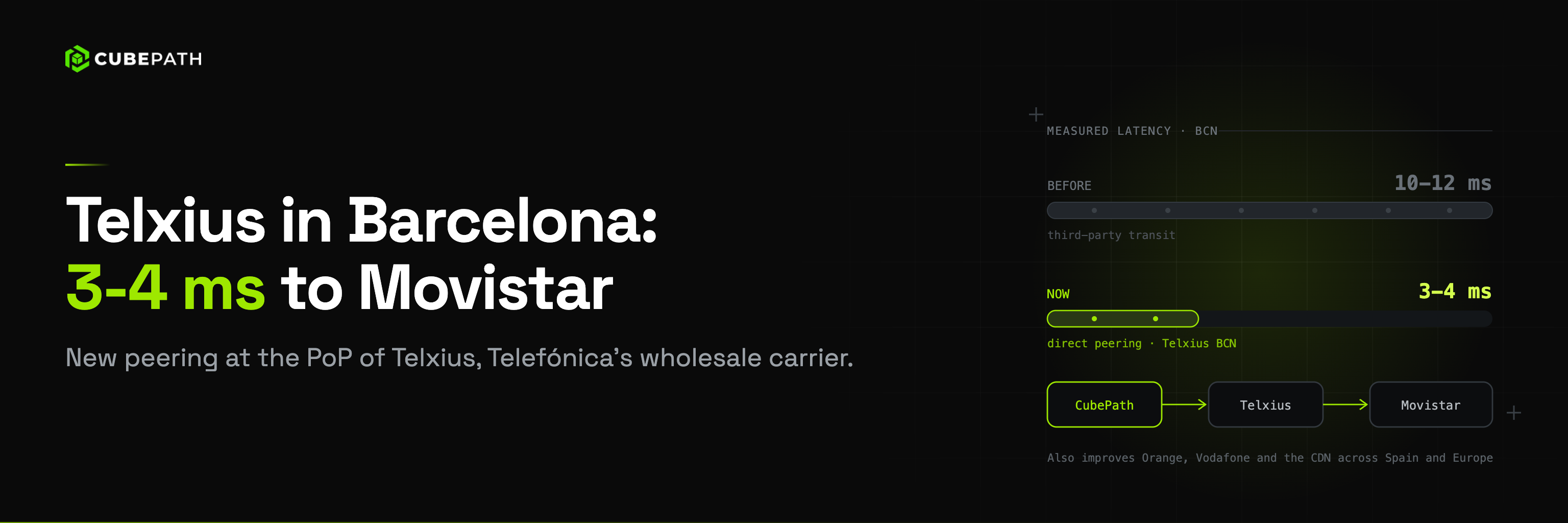
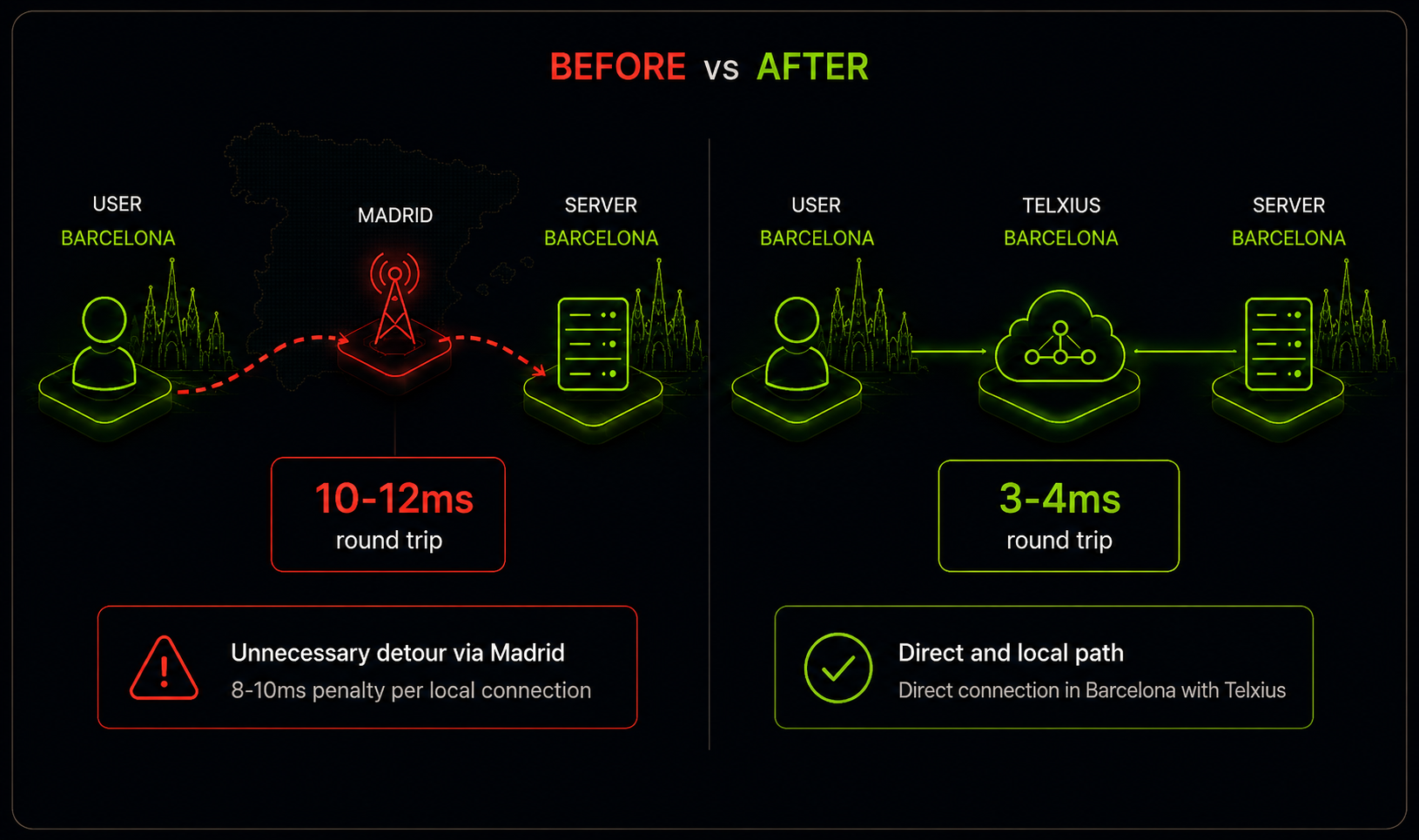
When someone in Barcelona orders a VPS in Barcelona, they expect one thing above all: low latency. It is the obvious reason to pick the datacenter in your own city. The market reality was different. That VPS "in Barcelona" responded in 10-12 ms, exactly the same as a VPS in Madrid would. Paying for proximity did not buy real proximity.
This was not a problem unique to us. It happens today to virtually every cloud provider with a presence in Barcelona. And the cause is not in the datacenters: it is in how the internet is routed in Spain.
We invested in fixing it the only way it can be fixed: by connecting Telxius at our Barcelona PoP. It is an expensive provider, probably one of the most expensive you can connect in Spain, and we did it anyway. This post explains why, with real measurements to back it up.
The Problem: A Barcelona VPS That Was Not Really in Barcelona
Before this investment, a Movistar user in Barcelona connecting to a server hosted in Barcelona saw latencies of 10-12 ms. The physical distance between their router and our datacenter could be a few kilometers, but their packets took an absurd trip: up to Madrid, across the interconnection points there, and back down to Barcelona.
And Madrid was not even the worst case. We have seen Telefonica traffic routed through London to reach Barcelona: a user and a server in the same city, with their packets crossing half of Europe and back because that is where the interconnection point with the destination network happened to be.
A Barcelona-Madrid round trip over fiber costs around 8-10 ms. That was the invisible toll paid by every local connection. And it was the reason ordering in Barcelona gave no advantage: the traffic went through Madrid anyway, so the latency was the same as ordering in Madrid.
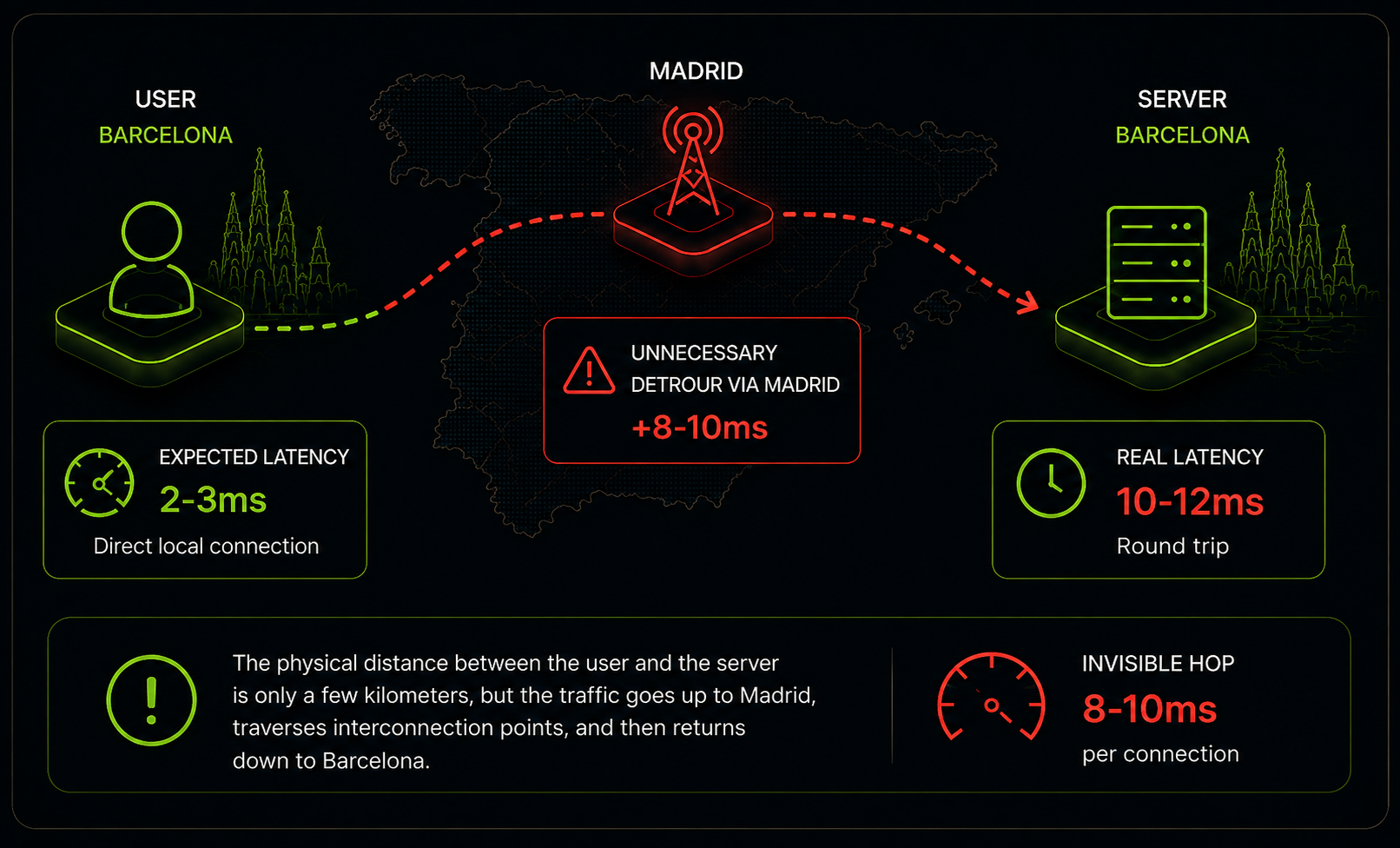
For workloads where latency really matters, that toll is the difference between a local experience and a mediocre one. And for us it was unacceptable that our Barcelona PoP could not offer Barcelona users the one thing a local datacenter promises by definition.
Why It Happens: In Spain, the Internet Lives in Madrid
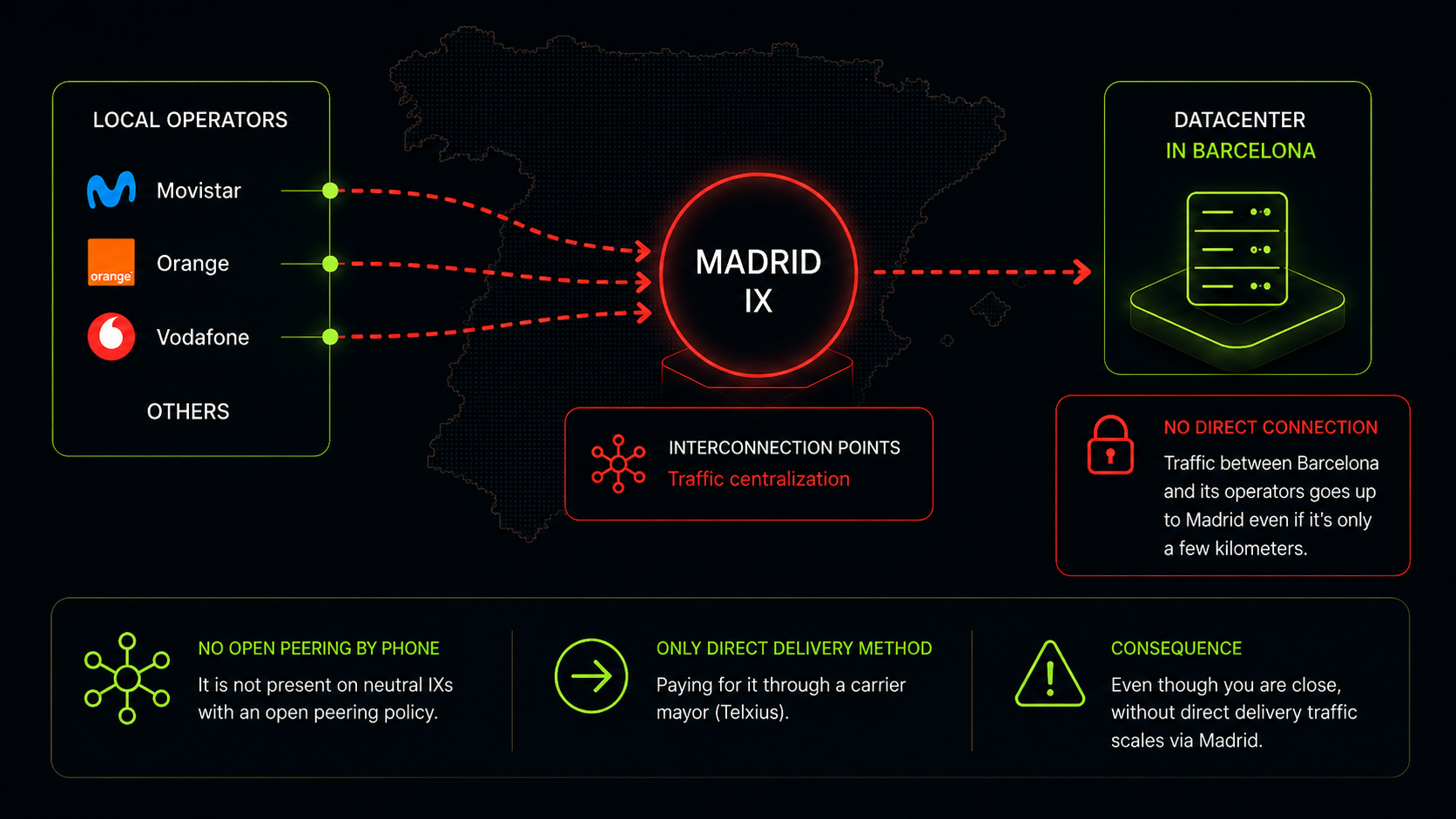
Barcelona is not the central point of the internet in Spain. Madrid is. Every local operator prioritizes routing through Madrid: it is where they concentrate their capacity, where their main interconnection points are, and where they exchange traffic with each other. The consequence is that traffic between two points in Catalonia can perfectly well end up making a stopover in Madrid.
On top of that there is a second factor that shapes the whole market: Telefonica does not do open peering with anyone. It is not present at neutral internet exchanges with an open policy, the way other European operators are. The only way to deliver traffic directly into Telefonica's network, the network with the most users in Spain, is to pay for it through their wholesale carrier.
The combination of both things explains the problem. Even if your server is two kilometers from the user, if your cloud provider does not have direct delivery into Telefonica in Barcelona, that traffic is going up to Madrid no matter what. And most providers do not have it, because it costs money. A lot of money.
The Solution: Telxius. And Yes, It Is Expensive
Telxius is the wholesale carrier of the Telefonica group. It is the direct door into Movistar's network, and one of the largest international backbones in existence, with presence across Europe and the Americas. And it is not just Movistar: Orange and Vodafone also peer with Telxius in Barcelona, so a single connection at our Barcelona PoP gives us direct, local delivery into Spain's three major networks. When you connect Telxius, traffic from those users reaches you over the shortest possible path, without depending on third parties or on detours through distant interconnection points.
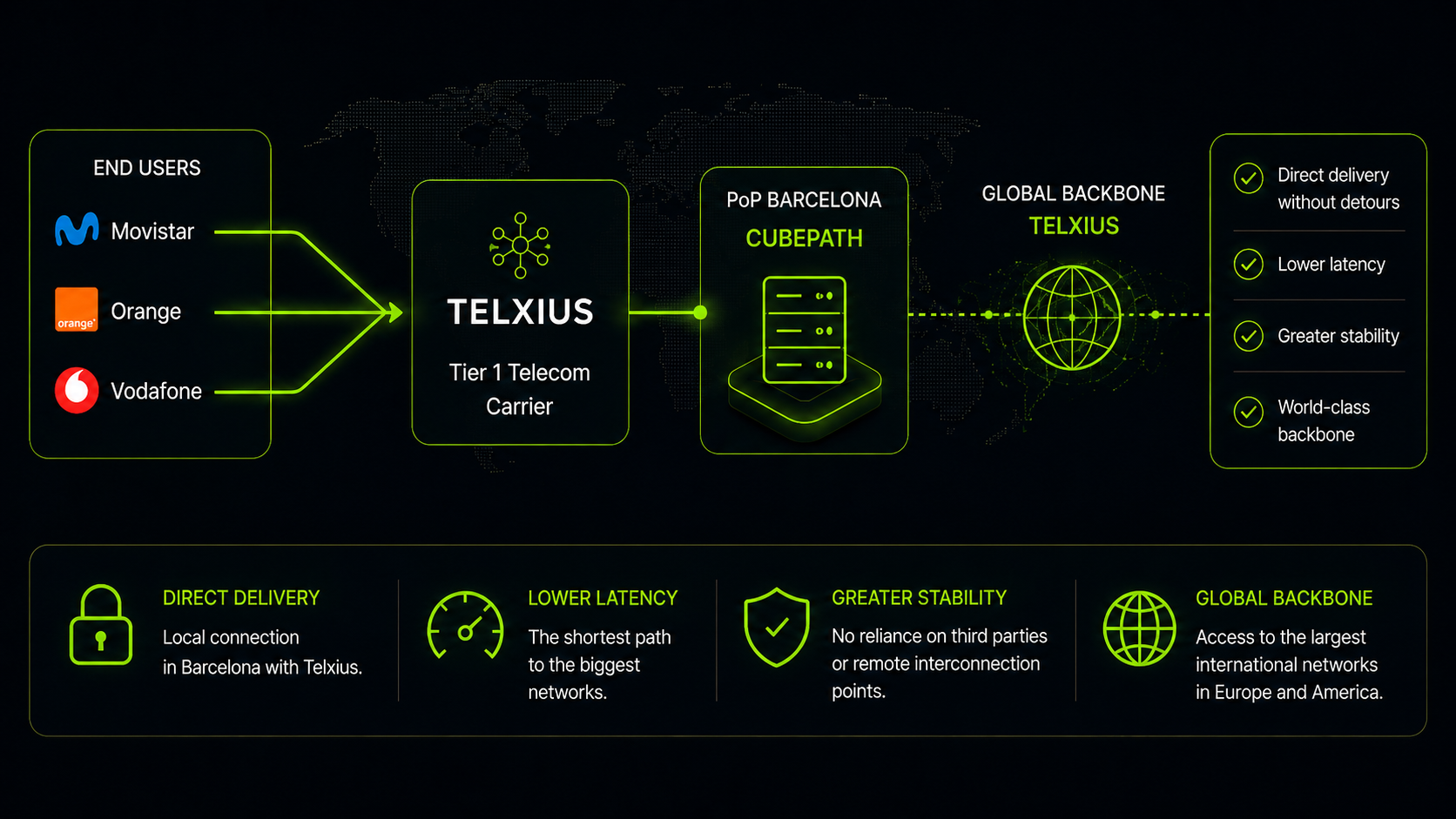
Let us be transparent: Telxius is an expensive provider. That is precisely why most cloud providers do not connect it and accept the Madrid detour as a lesser evil. It is the economically comfortable decision, and honestly, most customers would never know what that extra latency is due to.
In fact, our own VPS customers in Barcelona were not asking for this. Nobody opens a ticket to claim back 8 ms that every provider in the city loses equally: that latency is assumed to be normal because nobody offers anything better. It was not a market demand, and we did it anyway.
We did the math the other way around. Without direct delivery into Telefonica in Barcelona, our Barcelona PoP could not keep its promise. So we connected it, the same way we once decided to build our own global network with BGP multihoming instead of renting someone else's. The philosophy is the same: the network is the foundation of everything else, and we do not cut corners on the network.
That is why the Telxius connection in Barcelona does not only fix the path to Movistar: the same link solves the same problem for Orange and Vodafone users, who suffer variants of the same Madrid centralization, and it also strengthens our reach into the rest of Europe through one of the most capable backbones on the continent.
And Telxius does not work alone. Additionally, we are connected to DE-CIX Barcelona, the city's neutral internet exchange, where we peer locally with the domestic providers that do have an open peering policy. The strategy is complete: traffic that can be exchanged locally in Barcelona is exchanged locally, and Telxius covers the networks that are not at the exchange, starting with Telefonica's, which cannot be reached any other way.
The Numbers: Real Measurements
We do not want you to take our word for it. These are real MTR measurements taken with Globalping probes, from residential connections on different operators, towards our network in Barcelona (AS26141).
Let us start with the one that matters: a Movistar user in the Barcelona metropolitan area.
> Badalona, ES - Telefonica/Movistar (AS3352)
Host                                                                Loss%  Avg
1. AS???   _gateway (192.168.0.1)                                    0.0%  0.7
2. AS???   192.168.144.1                                             0.0%  3.2
3. AS3352  217.11.111.120                                            0.0%  3.3
4. AS3352  217.11.111.106                                            0.0%  3.4
5. AS3352  46.red-80-58-81.staticip.rima-tde.net                     0.0%  3.8
6. AS12956 213.140.50.204 (Telxius)                                  0.0%  3.5
7. AS12956 213.140.35.40 (Telxius)                                   0.0%  3.5
8. AS26141 cr002.bcn.eu.as26141.net (CubePath Barcelona)             0.0%  3.5
9. AS26141 194.26.100.14                                             0.0%  4.3
Look at what is happening there. The traffic leaves Movistar's network, enters Telxius (AS12956) while still 3.5 ms away from the user, and Telxius hands it to us directly at our Barcelona router. Total: 3.5-4 ms. No stopover in Madrid. Before this connection, that same user saw 10-12 ms, the same value they still see today with other Barcelona clouds.
The rest of Spain benefits from the direct delivery too. A Movistar user in Alicante:
> Alicante, ES - Telefonica/Movistar (AS3352)
Host                                                                Loss%  Avg
1. AS???   _gateway (192.168.144.1)                                  0.0%  1.4
2. AS3352  9.red-81-41-228.staticip.rima-tde.net                     0.0%  1.7
3. AS???   (waiting for reply)
4. AS3352  49.red-80-58-73.staticip.rima-tde.net                     0.0%  13.5
5. AS12956 213.140.50.204 (Telxius)                                  0.0%  12.5
6. AS12956 213.140.35.40 (Telxius)                                   0.0%  11.8
7. AS26141 cr002.bcn.eu.as26141.net (CubePath Barcelona)             0.0%  13.4
8. AS26141 194.26.100.14                                             0.0%  12.4
Movistar carries that traffic up to Madrid inside its own network, because that is how the Spanish network is built, and from there Telxius brings it to us in Barcelona in a straight line: 12-13 ms from Alicante is an excellent value for that distance.
The summary of all measurements, from different points in Spain and different operators, to our edge router in Barcelona:
| Origin | Operator | Measured latency |
|---|---|---|
| Badalona (Barcelona) | Movistar (AS3352) | 3.5-4 ms |
| Madrid | Orange (AS12479) | ~11-12 ms |
| Murcia | Movistar (AS3352) | ~12 ms |
| Alicante | Movistar (AS3352) | ~12-13 ms |
| Castro-Urdiales (Cantabria) | Orange (AS12479) | ~20 ms |
| Anguciana (La Rioja) | Vodafone (AS12430) | ~24 ms |
The CDN Gets Better Too
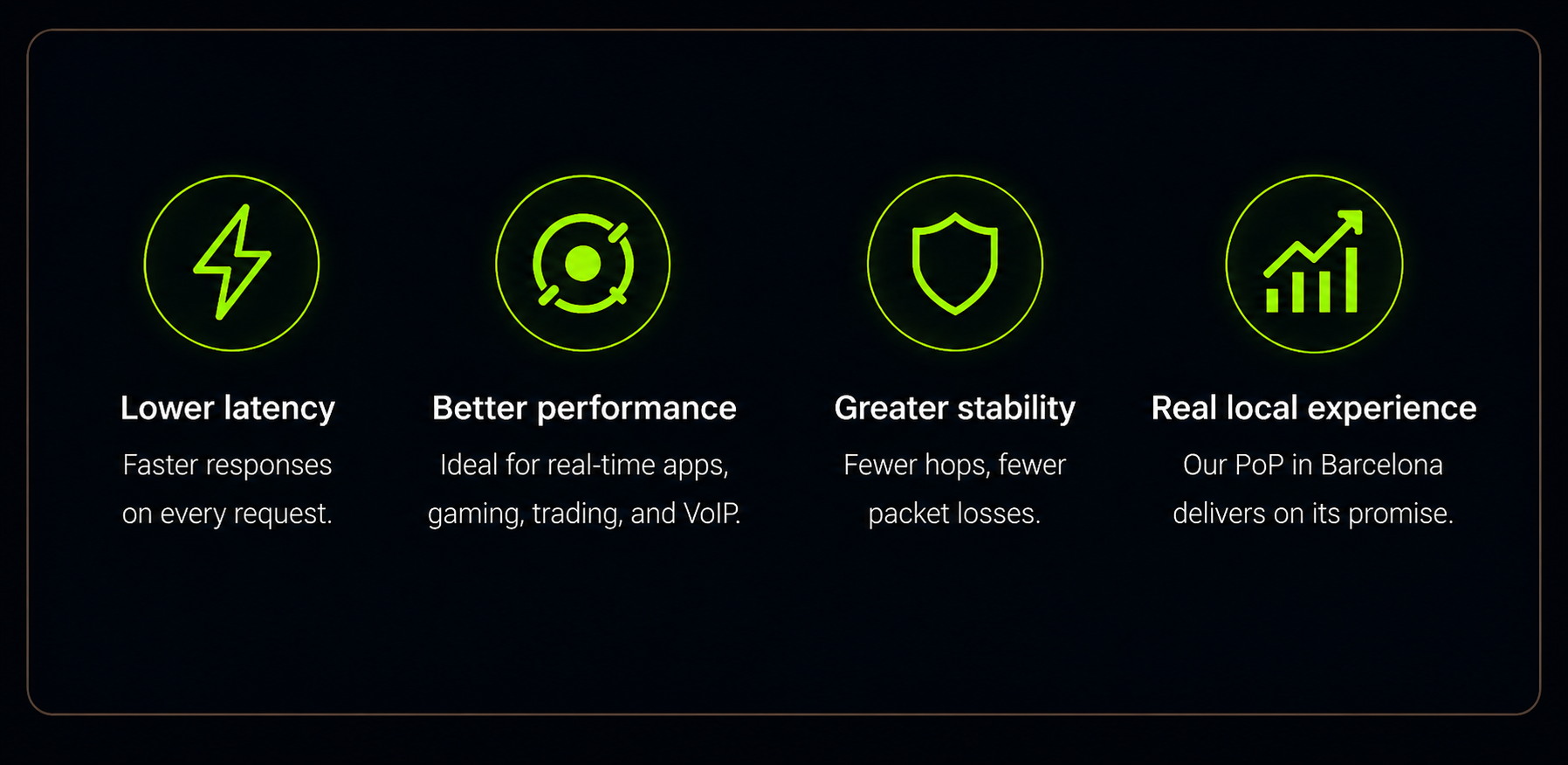
Our CDN is built on top of our own global network, so any improvement in the network automatically benefits the CDN. The Barcelona node now delivers content to Movistar users in the Barcelona area with that same 3-4 ms latency, which translates directly into better TTFB, faster TLS handshakes and a noticeably snappier experience on any website or application served from our CDN.
For users in the rest of Spain and Europe, direct delivery through the Telxius backbone shortens the return path into the networks of Telefonica, Orange and Vodafone across Telxius' entire footprint, which is enormous.
We Keep Betting on Barcelona
The Spanish market pushes everything towards Madrid: the capacity, the interconnection, the investments. The easy thing would be to accept that and treat Barcelona as a secondary PoP, which is exactly what most providers do. We keep doing the opposite: investing to make our Barcelona PoP a first-class point of presence, and the Telxius connection is one more step in that direction, not the last one.
Who cares about going from 12 ms to 3 ms? Anyone building something interactive: game servers where every millisecond of ping counts, trading platforms, VoIP and video conferencing, remote desktops, real-time APIs. And any Barcelona business that wants its local users to have the best possible experience, which is how local should always work.
If you are in Barcelona, or your users are, there is currently no option with better local latency. Deploy a VPS in Barcelona and measure it yourself, or contact us if you want us to look at your infrastructure's case together.