

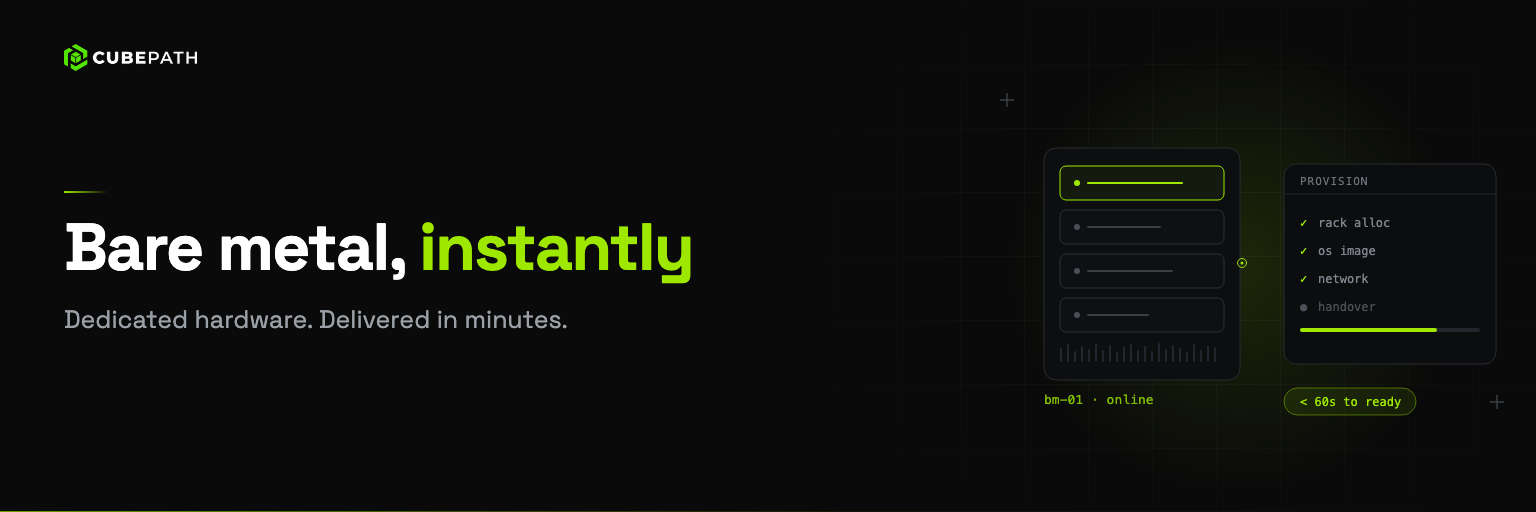
The traditional bare metal experience goes something like this. Open a support ticket. Wait 24 to 48 hours. Someone in a datacenter physically racks a server, installs an OS, runs some basic tests, and sends the credentials via email. Need to reinstall? Open another ticket. Need remote console access? Coordinate with support. Need a second server for a weekend project? Wait another two days.
That was acceptable a decade ago. It's not anymore.
CubePath bare metal servers deploy in minutes. From the panel, from the CLI, from the API. Pick the hardware model, choose the location and OS, and the server is ready. No tickets, no waiting, no humans manually racking anything. The same instant experience teams expect from cloud VPS, but on dedicated physical hardware with zero virtualization overhead.
Why Bare Metal Instead of VPS
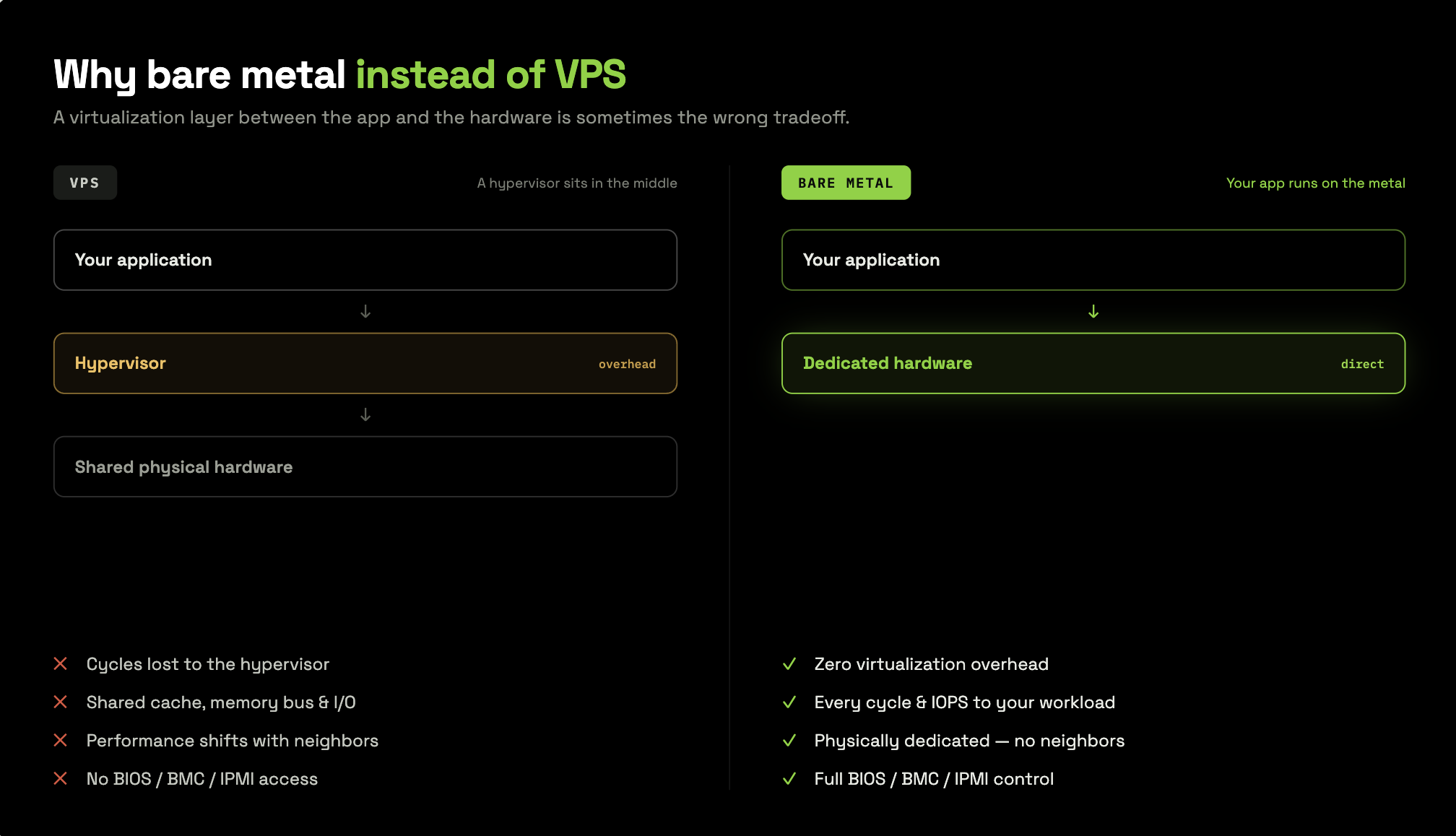
VPS instances are great for most workloads. But there are cases where a virtualization layer in between the application and the hardware is the wrong tradeoff.
No hypervisor overhead. On a VPS, there's always a hypervisor sitting between the application and the CPU. It's a thin layer, but it's there, consuming cycles, adding latency to I/O operations, and taking a slice of the available resources. On bare metal, the application runs directly on the hardware. Every CPU cycle, every byte of RAM, every IOPS from the NVMe drives goes to the workload. Nothing is lost to virtualization.
Predictable performance, always. On shared infrastructure, performance can fluctuate depending on what other tenants are doing on the same host. Even Dedicated CPU VPS instances, while guaranteeing cores, still share the memory bus, cache hierarchy, and I/O channels with other instances. Bare metal eliminates this entirely. The server is physically dedicated. There are no neighbors, noisy or otherwise.
Full hardware access. Configure BIOS/UEFI settings. Set up hardware RAID. Access the BMC for remote management. Run IPMI sessions for KVM console access. Monitor hardware sensors for temperatures, fan speeds, and voltages. This is real server hardware under full control, not a virtual abstraction of one.
Run your own virtualization. Need to run KVM, Proxmox, VMware, or any other hypervisor? Bare metal is the only option. You can't nest hypervisors on a VPS. With bare metal, the server is yours to run whatever you want on it, including your own virtualization stack.
Where Bare Metal Makes the Difference
- Large databases. PostgreSQL, MySQL, MongoDB at scale. When the dataset is hundreds of gigabytes or terabytes, direct NVMe access without a virtualization layer makes a measurable difference in query latency and throughput.
- Compilation and CI/CD. Large codebases that take hours to compile benefit from raw CPU access. CI/CD pipelines running heavy test suites finish faster on bare metal.
- Data processing. ETL pipelines, analytics workloads, log processing. Anything that moves large volumes of data through CPU and disk benefits from removing the virtualization layer.
- Rendering and encoding. Video encoding, 3D rendering, image processing. CPU-bound tasks where every cycle matters.
- Custom networking. Applications that need raw socket access, custom kernel modules, or network configurations that aren't possible inside a virtual machine.
Instant Delivery: Bare Metal in Minutes
CubePath maintains a stock of pre-provisioned bare metal servers across its locations, ready to deploy on demand. This isn't a "request and wait" model. It's the same instant provisioning that cloud teams expect.
From the panel. Select the hardware model, choose a location, pick an OS template, and deploy. The server provisions automatically, the OS installs, and credentials are available in the panel within minutes.
From the CLI. One command:
# Deploy a bare metal server
cubecli baremetal deploy

# List available models
cubecli baremetal model list

# List your bare metal servers
cubecli baremetal list

# Show server details
cubecli baremetal show <id>
From the API. The same API that manages VPS, Load Balancers, DNS, and every other CubePath resource also provisions bare metal. Integrate it into automation workflows, Terraform, or custom tooling.
The provisioning is fully automated. There's no human in the loop racking servers or running cables. The hardware is pre-staged, the network is pre-configured, and the OS installation is automated. That's what makes minute-level delivery possible.
Auto-Installation: Deploy, Use, Reinstall, Repeat
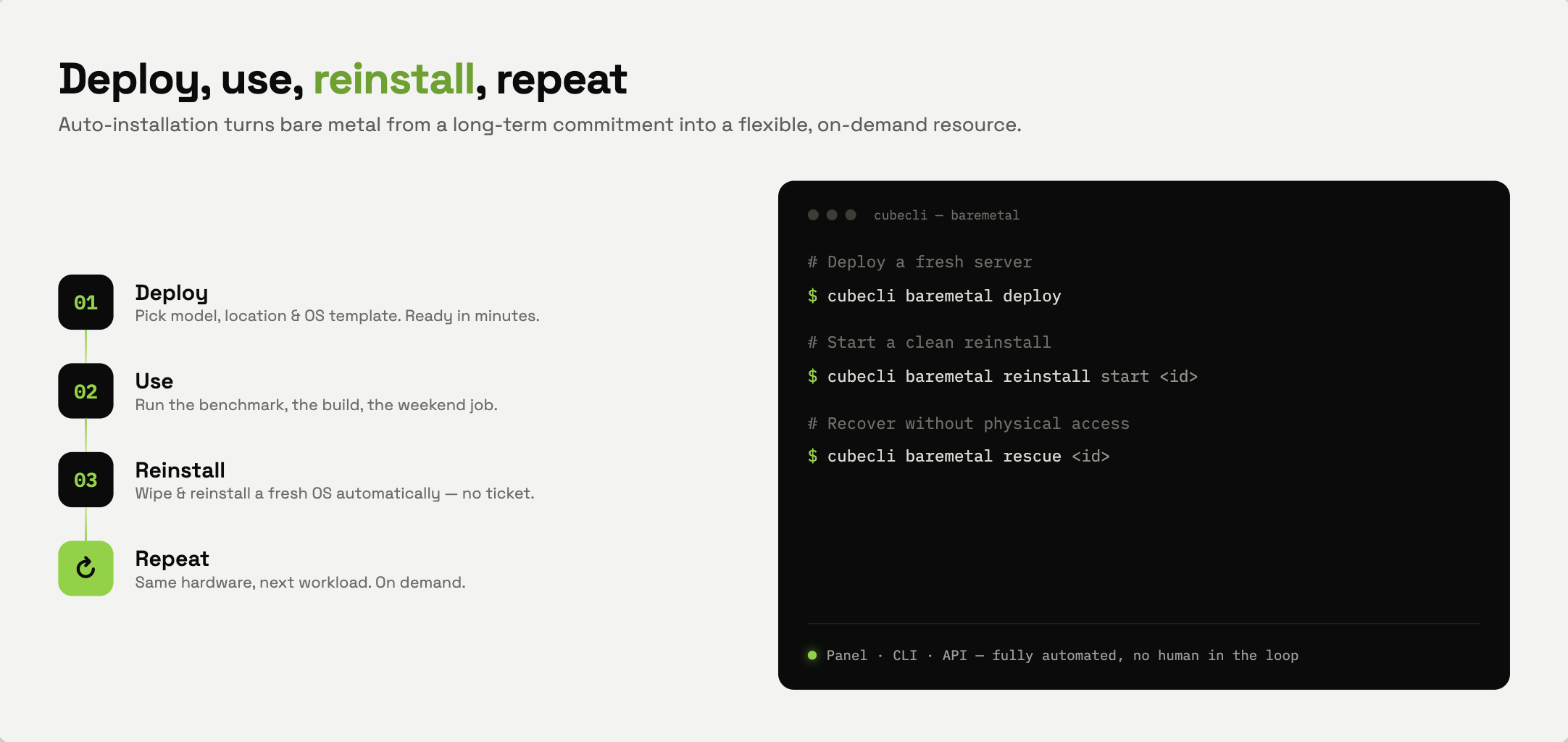
One of the things that traditionally makes bare metal inflexible is the OS installation process. On a VPS, reinstalling takes seconds. On traditional bare metal, it means opening a ticket or booting into an installer manually via IPMI.
CubePath bare metal handles OS installation the same way cloud instances do: automatically.
Multiple OS templates. Debian, Ubuntu, Rocky Linux, CentOS, Windows Server. Select a template and the system installs it from scratch on the bare metal hardware. No ISO mounting, no manual partitioning, no waiting for a technician.
Reinstall anytime. Need a clean slate? Reinstall the OS from the panel, CLI, or API:
# Start a reinstall
cubecli baremetal reinstall start <id>

# Check reinstall status
cubecli baremetal reinstall status <id>
The server wipes and reinstalls automatically. In minutes, it's back with a fresh OS, ready for the next workload.
Rescue mode. Something went wrong and the server won't boot? Boot into rescue mode for diagnostics and recovery without needing physical access:
cubecli baremetal rescue <id>
This changes how bare metal gets used. It's no longer a server that gets provisioned once and runs for years. It can be a resource that's deployed for a specific task and reinstalled or released when the task is done. Need a powerful server for a 4-hour benchmark? Deploy, run the benchmark, done. A weekend-long data processing job? Deploy Friday, process over the weekend, reinstall Monday. The auto-installation turns bare metal from a long-term commitment into a flexible resource.
Full Remote Management from CLI and API
Physical servers traditionally require physical access for many management tasks. CubePath bare metal eliminates that by exposing everything through the CLI and API:
Power management. Start, stop, restart, or hard reset the server remotely:
cubecli baremetal power start <id>
cubecli baremetal power stop <id>
cubecli baremetal power restart <id>
BMC sensor data. Monitor hardware health without logging into the server. Temperatures, fan speeds, voltages, power consumption:
cubecli baremetal sensors <id>
IPMI console access. Need to see the boot screen, access the BIOS, or debug a kernel panic? Create an IPMI proxy session for remote KVM access:
cubecli baremetal ipmi <id>
BMC reset. If the management controller becomes unresponsive, reset it without affecting the running server:
cubecli baremetal reset-bmc <id>
Monitoring toggle. Enable or disable CubePath's monitoring for the server:
cubecli baremetal monitoring enable <id>
cubecli baremetal monitoring status <id>
Everything that would traditionally require a trip to the datacenter or a support ticket is available from the terminal. Script it, automate it, or use it for quick ad-hoc management.
Connected to the CubePath Ecosystem
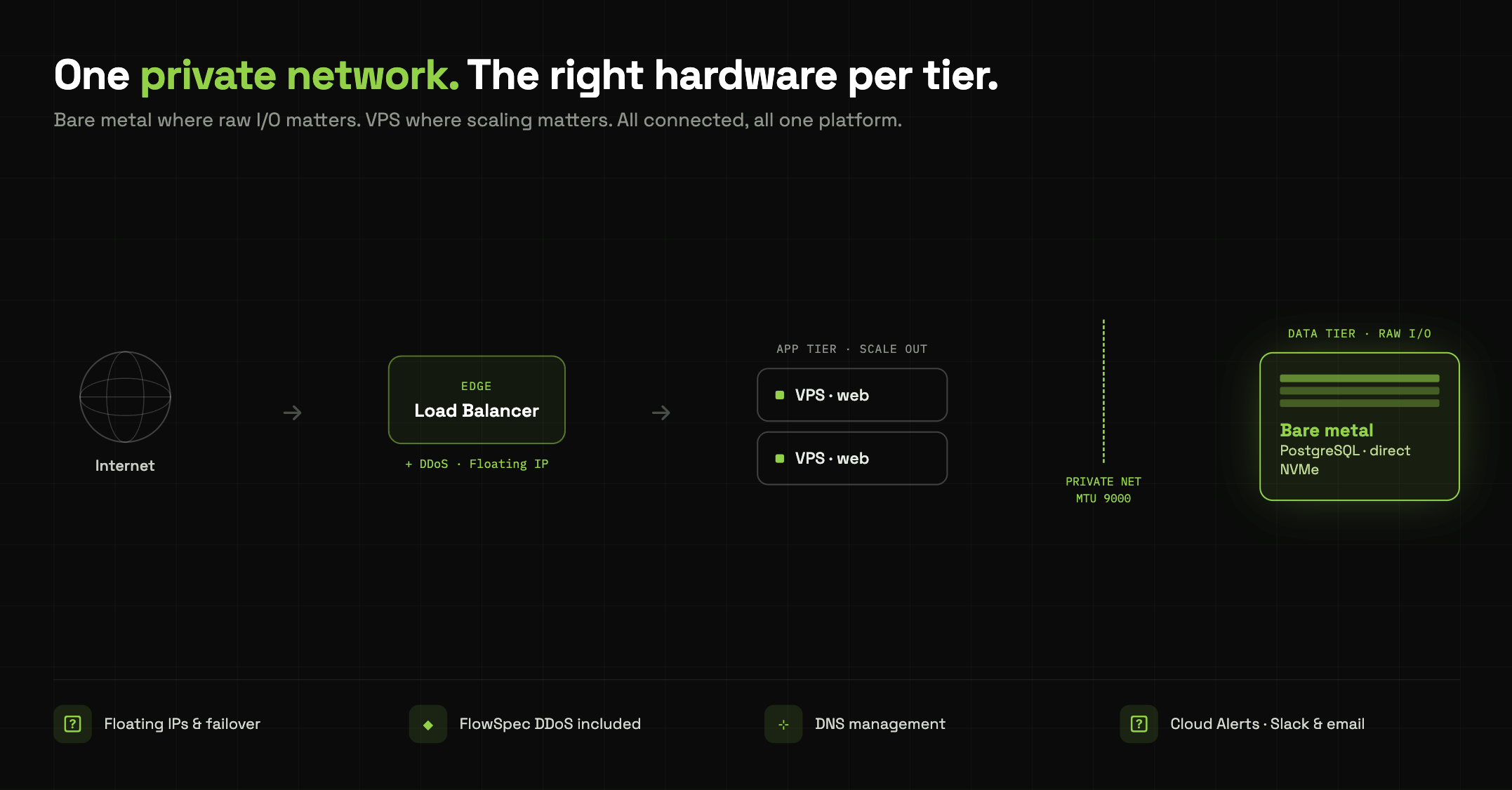
A bare metal server in isolation is powerful but limited. What makes CubePath bare metal useful for production architectures is that it plugs into the same ecosystem as everything else on the platform.
Private networking with MTU 9000. Connect bare metal servers to VPS instances on the same private network. The database runs on bare metal for maximum performance, the application servers run on VPS behind a Load Balancer, and they communicate over the private network with jumbo frames. No public internet traffic, no bandwidth charges, maximum throughput.
Floating IPs. Assign a Floating IP to a bare metal server and move it instantly to another server if the primary fails. Same instant failover mechanism as VPS, but on dedicated hardware.
DNS management. Point domains at bare metal servers using the same DNS management that handles the rest of the infrastructure. One panel, one API, one place to manage everything.
DDoS protection included. Every bare metal server is protected by CubePath's FlowSpec-based DDoS mitigation on the edge routers. The same protection that covers VPS instances covers bare metal. No extra configuration, no additional cost.
Cloud Alerts. Set up resource alerts and receive notifications via Slack, Email, or other channels when something needs attention. Monitor the servers that matter most without building monitoring infrastructure from scratch.
Hybrid architectures. The real power is in combining bare metal with the rest of CubePath's platform. Bare metal for the database tier where raw I/O performance matters. VPS instances for the application tier where horizontal scaling is more important. Load Balancers in front distributing traffic. Private network connecting everything. This is a production architecture where each component runs on the hardware type that fits its workload.
Who CubePath Bare Metal Is For
Teams that need raw performance without virtualization overhead. When the benchmark shows a 15% difference between virtualized and bare metal, and that difference matters for the workload, bare metal is the right choice. Databases, compilation, encoding, heavy computation.
Workloads that require dedicated hardware. Compliance requirements, licensing tied to physical cores, applications that need direct hardware access, custom kernel configurations. Some workloads simply need to run on a dedicated physical server.
Teams that need bare metal but refuse to wait days. The traditional bare metal provisioning experience is broken. CubePath fixes it with instant delivery, automated OS installation, and full remote management. Bare metal with cloud speed.
Teams that automate infrastructure. If bare metal can't be managed through an API or CLI, it doesn't fit into modern infrastructure workflows. CubePath bare metal is managed with the same tools and patterns as VPS: CLI, API, automation. No tickets, no manual processes.
Hybrid infrastructure builders. Teams that want the right hardware for each workload. Bare metal where it matters, VPS where it's more practical, all connected on the same private network and managed from the same platform.
Bare Metal with a Cloud Experience
CubePath bare metal is what happens when dedicated hardware gets the cloud treatment. Instant delivery. Automated OS installation. Full remote management via CLI and API. Private networking with VPS. Integrated into the same platform, same panel, same API as everything else.
Dedicated hardware doesn't have to mean slow provisioning, manual management, and isolation from the rest of the infrastructure. It can be fast, automated, and connected. That's what CubePath built.